Join Blob Clash 3D: Mob Runner
- 4.5
- Rating
- 50.00M
- Installs
- Free
- Price
 Analysis by App-foxy
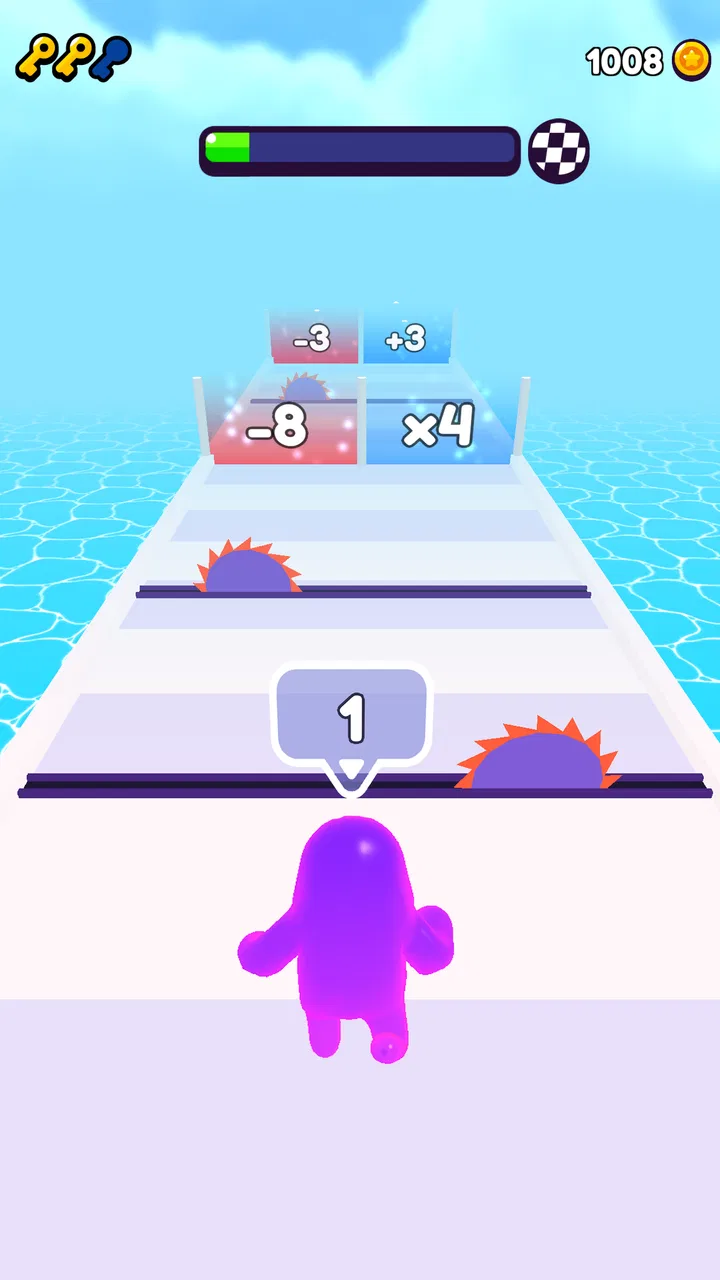
I first approached Join Blob Clash 3D: Mob Runner expecting a quick arcade distraction, and that is exactly where it makes the most sense. The game puts me in charge of a growing group of jelly-like runners, asking me to move through crowded courses while trying to keep the mob together and reach the finish with as much momentum as possible. It is bright, immediate, and easy to understand within a few seconds.
That simplicity is both its strongest quality and its main limitation. I do not need to learn a complicated control scheme or spend time reading instructions before playing. At the same time, anyone looking for a deep campaign, a detailed story, or a carefully layered strategy game will probably find the experience too light. This is an arcade game built around short bursts of movement, quick reactions, and the satisfying visual effect of a small blob crowd becoming larger.
CASUAL AZUR GAMES keeps the presentation focused on that central idea. The store summary describes a crowded jelly race, and in practice the appeal comes from guiding runners through hazards and opportunities without losing control of the group. I found it most enjoyable when I treated each attempt as a compact challenge rather than expecting a long play session with major narrative progress.
You May Also Like

 Blood Strike: 2.5 Anniversary
Blood Strike’s Loadouts Turn Every Drop Into a Tactical Gamble
A close look at Blood Strike’s custom loadouts: how fast access to signature weapons reshapes its battle royale rhythm, rewards preparation, and narrows the gap between fights.

 Pandora - Music & Podcasts
Pandora’s Music Is Easy to Start, but Harder to Recover
Pandora’s strength is its low-effort path from a seed to a station. Its weak spot is how much confidence it asks you to place in connection, setup, and quiet recovery.

 8 Ball Pool
 Is Built on Rivalries, Rematches, and Routine
A close look at the rivalries, rematches, shared routines, and unanswered safety questions that turn a quick pool match into a persistent mobile community.

 Samsung Music
’s Quiet Strength Is Playing What You Already Own
Its reach comes less from spectacle than from dependable access to a personal library. That simplicity is both the app’s strongest retention engine and its ceiling.

 AccuWeather: Weather Radar
AccuWeather Review: A Quick, Clear Forecast for Everyday Decisions
For everyday plans, the best forecast is the one you can understand quickly. AccuWeather makes rain timing, radar, and local conditions easy to act on, with a few trade-offs.

 Hill Climb Racing
Why Hill Climb Racing Still Turns Crashes Into One More Run
A tiny car, a bumpy hill and one more upgrade: Hill Climb Racing keeps resurfacing because its simple chaos makes every near-miss feel personal.
More From Our News Desk



How the early goals make the game understandable
The first thing that works well is the clarity of the opening objective. I am not asked to manage several resources, memorize a map, or understand a complicated upgrade tree before having fun. The immediate goal is simply to move the blob crowd through the course and make sensible decisions while the action is unfolding. That makes the game approachable for someone who wants something playable during a short break.
The early stages also communicate the basic rhythm naturally. I watch the path, steer the group, react to obstacles, and try to arrive in better shape than I might have managed on the previous attempt. The crowd gives every movement visible weight: a mistake does not feel like moving a single character into danger, because I can see the effect spread across the whole group.
That visual feedback is important. A traditional endless runner often makes me focus on one avatar and a sequence of individual jumps or lane changes. Here, the mob itself is the object I care about. Even when the underlying action is straightforward, seeing the blobs bunch together, pass through tight spaces, or lose members gives the run a more physical feeling than a standard solo runner.
My advice for new players is to avoid rushing simply because the game looks fast and colorful. The useful early habit is to read the route before committing to a direction. A larger group can feel powerful, but it can also make poor positioning more costly. I got better results when I treated the crowd as something that needs room to move rather than as a single point that can be thrown anywhere.
The game suits people who enjoy goals that are visible immediately. I can understand what a successful run should look like without consulting a guide. That is a real advantage for casual play, especially when I am opening the game with only a few minutes available. However, players who need a strong sense of long-term purpose may notice that the early motivation is mostly tied to improving the next run and seeing how far the current challenge can take them.
Why the crowd changes the usual runner formula
The mob format gives the controls a different kind of tension. In a normal runner, I often think about the exact position of one character. With the jelly crowd, I think about the shape and safety of the entire group. A route that looks acceptable for one runner may be awkward for a larger cluster, so the best choice is not always the most direct one.
This creates a useful trade-off between speed and control. Moving aggressively can help me maintain momentum, but it can also leave less time to correct a bad line. Taking a more careful route may feel slower, yet preserving the group can make the final approach more satisfying. The game does not need a complicated rulebook to create this decision; the crowd makes the consequence visible.
One practical technique I found helpful was to make small steering adjustments instead of holding a direction for too long. Broad movements are tempting because the action is simple, but they can push the mob toward trouble before I have time to react. Gentle corrections keep the group more centered and give me a better chance of responding when the course narrows.
Progress signals and the feeling of getting better
The most convincing form of progress here is personal improvement. I notice it when a route that initially felt chaotic becomes readable, or when I finish with better control because I have learned where my first attempt went wrong. That kind of progress is modest, but it is honest: the player’s growing familiarity matters more than a complicated collection of systems.
The game’s appeal depends heavily on whether I enjoy repeating short challenges. If I like trying again immediately after a mistake, the structure feels inviting. A failed run can teach me to approach a section differently, adjust my timing, or stop making the same impulsive movement. If I dislike repetition without a strong story or substantial new objective, the loop may begin to feel thin.
There is also a satisfying visual signal in maintaining a larger crowd. The group’s size and movement make success easy to read at a glance. I do not need to inspect a detailed statistics screen to know that a run went well; the fuller, more confident mob communicates that result during play. This is one of the game’s better design choices because it connects the goal directly to what is happening on screen.
Still, I would not describe the progression as deep. The experience is more about repeated attempts and immediate arcade satisfaction than about building a complex character over time. That distinction matters when deciding whether to install it. Someone who wants a compact game for reflex practice may appreciate the directness, while someone expecting extensive unlocks, elaborate customization, or a long-form campaign should choose a different type of mobile game.
The game is free, which lowers the barrier to trying it. Its content rating is Teen, and the current version is 0.3.71. It runs on Android 7.0 or later, so it is accessible on a broad range of devices that still support that operating system. In-app purchases are listed at $11.99 per item, so I would approach optional spending carefully and decide first whether the basic loop holds my attention without it.
That last point is especially relevant for a short-session arcade title. I would not spend money simply because I had a frustrating run. I would first ask whether the problem came from the game’s challenge or from my own impatience. The free entry makes that test straightforward: play enough to learn the controls, see how the pacing develops, and only then decide whether any purchase feels worthwhile for your habits.
Who will notice the progress most
This is a good match for players who enjoy visible, immediate improvement. A commuter waiting for a connection, for example, can play a few attempts, put the phone away, and return later without needing to remember a complicated plot. The same works for someone who wants a light game after work but does not want to commit to a long session or manage a large inventory.
It is less suitable for players who measure progress mainly through story chapters, deep build choices, or highly varied missions. The mob itself is the central attraction, so the experience can feel repetitive if that visual and mechanical idea does not stay interesting for you. I also would not recommend it as a replacement for a precision platformer if your priority is exact jumping, advanced movement, or demanding level mastery.
Compared with a usual solo endless runner, the game offers a stronger sense of group management and a more playful visual identity. Compared with a traditional puzzle game, it asks for faster reactions and less planning away from the course. Compared with a large action game, it is much easier to pick up but far less ambitious. Its best position is between those alternatives: a quick arcade challenge with a distinctive crowd mechanic.
Difficulty, pacing, and the pressure to keep playing
The difficulty works best when I treat it as a lesson in control rather than a test of speed alone. Early success can make the game feel effortless, but that is partly because the basic route is easy to understand. As I become more confident, I naturally take sharper lines and make more ambitious movements. That is where mistakes become more likely, and the game’s challenge begins to come from my decisions as much as from the course itself.
I appreciate this kind of difficulty because it gives me some responsibility for failure. When I lose part of the group or fail to finish cleanly, I can usually identify a moment where I moved too quickly or chose a poor position. The result feels more useful than a random loss. I can try again with a specific adjustment rather than simply hoping the next attempt is kinder.
There is a trade-off, though. A game built around repeated runs can encourage me to chase one more attempt even when I am no longer paying attention. The short format makes restarting easy, and that convenience is enjoyable until it turns into automatic repetition. I found it better to stop after a few unfocused failures and return later, because tired reactions made the controls feel less reliable than they actually were.
The pacing is strongest when the course gives me enough time to read what is ahead but still asks for a decision before I can overthink it. That balance keeps the action active without making it feel completely random. I would have preferred more variety if I were playing for a long stretch, but in short sessions the compact rhythm is one of the reasons the game works.
One non-obvious strength is that the crowd makes risk easier to evaluate emotionally. I am not only thinking about whether my lead position survives; I am judging whether a risky move is worth exposing the rest of the mob. That creates a small but meaningful layer of decision-making. The game remains accessible, yet it is not entirely mindless when I pay attention to how movement affects the group.
Where the retention loop may lose its grip
The same simplicity that makes the game welcoming can limit its staying power. If the main satisfaction comes from guiding the blobs through another course and improving the result, players who need frequent new mechanics may eventually feel that the loop has shown them everything important. I think the game is better as a repeatable snack than as the only game installed on a phone.
The large audience suggests that the format has broad appeal: it has a 4.5 average from around 32 thousand ratings and has passed 50 million installs. Those figures place it among widely tried mobile arcade games, but they do not change the personal question of whether I enjoy repeating its central challenge. Popularity can tell me that the concept is accessible; it cannot guarantee that the pacing will suit every player.
The Teen content rating is worth keeping in mind for families choosing games for younger children. I would check the device and account settings before handing it to a child, particularly because the game includes in-app purchases. The listed price of $11.99 per item makes purchase awareness more important than it might be in a completely purchase-free title.
I also think the game benefits from being played with a clear purpose. I might open it to relax for a few minutes, to practice cleaner movement, or to see whether I can improve a recent result. I enjoy it less when I expect it to provide a large stream of new content every time I launch it. Setting the right expectation prevents the simple design from feeling like a flaw.
For a realistic everyday scenario, imagine having ten minutes before an appointment. I can play several attempts, learn from a poor turn, and stop without leaving a complicated mission unfinished. That is where the game feels most natural. On a long flight or during an evening when I want a substantial gaming experience, I would probably choose something with deeper progression and more varied activities.
My progression verdict after spending time with it
My overall view is positive, but deliberately limited. Join Blob Clash 3D: Mob Runner succeeds because it makes the crowd the star of every decision. The goal is clear, the action is easy to start, and the visual feedback makes improvement satisfying. I like that I can understand the game quickly while still having room to improve my steering and judgment.
The progression is not designed to carry a long, story-driven adventure. Its structure is better understood as a series of compact arcade tests where the reward is cleaner play, a stronger finish, and the pleasure of keeping the mob together. That can be enough when I want a quick challenge, but it will not satisfy everyone looking for extensive unlocks or a rich sense of character development.
My strongest recommendation is for casual players who enjoy colorful runners, short attempts, and visible consequences. It is also a good choice for anyone who likes the familiar runner format but wants the added pressure of protecting a group rather than a lone character. I would skip it if you need deep strategy, a narrative campaign, or constant mechanical reinvention.
Before installing, I would make sure the device meets the Android 7.0 minimum and remember that the game is free to start, with optional purchases listed at $11.99 per item. I would also keep the Teen rating in mind. Those details do not define the quality of the core game, but they matter when deciding whether it fits your phone, your household, and your spending preferences.
In the end, I see this as a focused arcade game rather than a complete all-purpose mobile experience. Its best moments come from reading a route, making a careful adjustment, and watching the jelly crowd reach the finish in better shape than before. If that compact loop sounds appealing, the free entry makes it easy to try. Just go in expecting quick runs and gradual mastery, not a large progression system that will occupy every evening.
FAQs for Join Blob Clash 3D: Mob Runner
01What is the main objective of Join Blob Clash 3D: Mob Runner?
Join Blob Clash 3D: Mob Runner is an engaging runner game where your goal is to navigate through various obstacles, gather more blobs to grow your mob, and face off against formidable bosses. The game emphasizes quick reflexes and strategic planning as you aim to build the largest and most powerful blob army possible.
02Is Join Blob Clash 3D: Mob Runner suitable for all ages?
Yes, Join Blob Clash 3D: Mob Runner is designed to be family-friendly and suitable for players of all ages. Its vibrant graphics and simple gameplay mechanics make it easy for younger players to enjoy, while its increasing difficulty provides a challenge for older gamers. Parental guidance is recommended for very young children.
03Does Join Blob Clash 3D: Mob Runner require an internet connection to play?
Join Blob Clash 3D: Mob Runner can be played offline, making it a great option for on-the-go gaming without the need for a constant internet connection. However, an internet connection is required if you wish to access certain features like in-app purchases or social media integration for sharing high scores.
04Are there any in-app purchases in Join Blob Clash 3D: Mob Runner?
Yes, Join Blob Clash 3D: Mob Runner offers in-app purchases that allow players to enhance their gaming experience. These purchases typically include power-ups, additional skins, and other customization options. While the game can be enjoyed without spending money, these purchases can provide an advantage or aesthetic diversity.
05What are the device requirements for Join Blob Clash 3D: Mob Runner?
Join Blob Clash 3D: Mob Runner is available on both Android and iOS platforms. It requires Android version 5.0 or higher and iOS 10.0 or later. The game is optimized for a wide range of devices, but for the best experience, it is recommended to play on a device with decent processing power and memory.
Pros
- Engaging 3D graphics enhance gameplay.
- Simple controls suitable for all ages.
- Regular updates with new levels.
- Fun multiplayer mode available.
- Low storage requirement for installation.
Cons
- Contains ads that can interrupt play.
- Requires internet for most features.
- In-app purchases can be pricey.
- Limited customization options.
- Occasional lag on older devices.

Join Blob Clash 3D: Mob Runner
Gallery